Questions Nobody Asked
Straight answers, from why the kits don't include chlorine to how this product came to exist.
Jump to a question
- How is this different from PUR?
- Your MSDS CAS # and packaging don't completely match.
- Your kits only "pre-treat" water.
- Why don't you include chlorine?
- Those demos that show a guy sucking water out of a filthy ditch are awesome. Why do I need this?
- Can't I just throw some alum in water for coagulation/flocculation and call it good?
- I know nothing about chemicals, there are a lot of them, and it's heavy. What should I do?
- I poured a lb of dirt into 1 L of water and the water is still cloudy after treatment, this stuff doesn't work.
- It still doesn't work.
- I know a bit about water chemistry. What is a good starting point?
- pH adjustments
- Why is there a time limit on how long this is usable?
- My water isn't crystal clear after the chemicals.
- Why hasn't this been done before?
- Why am I only hearing about this now?
- These chemicals are cheap. Why are you selling them for that price?
- What else can it do?
- This product is too heavy to take camping.
- Why?
1. How is this different from PUR?
PUR is a philanthropic program run by Procter & Gamble to provide easily accessible safe water in areas that don't have it. Each sachet purifies 2.5 gallons of water and, when not donated, can cost over $1 at retail. If you need 2.5 gallons of water cleaned, it's a great solution.
What if what you wanted to do wasn't solved by that packet? Maybe it was 2,500 gallons that sheeted off your roof. This kit answers that question. You have a water problem that would benefit from chemical treatment, and you need the tools. You know not to eat the chemicals and that there may be post-processing needed. You probably passed Chemistry for STEM majors with better grades, too. However, you've never had access to those chemicals.
I wanted all the same options my municipal water provider had for taking water from unusable to maybe usable, and everyone I asked if I could order some from said, "no." That is, if they returned my calls or e-mails. I should have taken the hint.
2. Your MSDS CAS # and packaging don't completely match.
Unfortunately, the MSDSs I originally received from my supplier, which were the original basis for the packaging, weren't sufficiently correct for Amazon or really even me. Amazon requires the standard 16-category REACH Safety Data Sheet (SDS). The provided MSDSs have seen a massive improvement in accuracy and completeness since then, and future packaging will reflect the updated MSDS and product instructions. The website and current MSDS reflect the updated information. Once you order something and have it filled, it's really hard to make corrections, especially if you make a lot of them. The packaging was designed almost a year ago, and the MSDS re-writes happened within the last quarter. CAS numbers aren't inaccurate in any case, but sometimes there were more specific variants vs. less specific variants, and often the less specific variant's CAS number was what ended up on the packaging. In no case do the safety recommendations change.
If this product makes it to a version 2, there is a very long list of changes that are planned.
3. Your kits only "pre-treat" water.
All water sanitation methods work best when their input is clear. After removing the visible particles from water, you have options. You can chlorinate it, boil it, use other virus and parasite inactivation products, use a filtering straw, or even use UV/ozone to make water safe to drink.
This kit gives you the opportunity to decide what purification method is appropriate for your use case. For example, maybe you have one 5-gallon bucket of water chlorinated with bleach at 5 ppm that sat outside for 24 hours, covered with clear wrap, on a high-UV day, and is used for hand washing. Maybe another 5 gallons is made clear and has a few drops of bleach in it, but is consumed through membrane straws. Perhaps another 5-gallon bucket of water is made clear and then put into individual bottles, and you add a product like Aquatabs to it at the point of use. The cost of every 5-gallon bucket is negligible, so make as many as you'd like.
4. Why don't you include chlorine?
As of this writing, September 2026, a 1-quart bottle of Cloralen regular (5%) bleach sells for $1.78 on Amazon. If used in enough quantity for long enough, it will kill just about anything, including you. Unfortunately, Cryptosporidium and Giardia are sometimes chlorine resistant, so they will likely need more bleach or calcium hypochlorite (cal hypo) than you'd like in your drinking water. I suggest pairing this kit with downstream products that have demonstrated their ability to kill the bacteria, viruses, and parasites of concern to make water safe to drink. Aquatabs and membrane straws work well for this. Chlorine at a high enough level will kill parasites, but it won't taste good, and UV will destabilize chlorine over time.
After considering the costs of compliance for importing EPA-registered pesticides and chemicals that make "pesticidal claims," I decided I could not afford to, and I left it to someone else to deal with the part where the water made you sick because the sanitizer didn't work. The products aim to improve water clarity; beyond that, you are in control.
The CDC's recommendation: How to Make Water Safe in an Emergency.
The CDC specifically notes that cloudy water is more difficult to sanitize (it says to filter or settle cloudy water first, or to double the bleach), and it recommends boiling water to kill microorganisms.
5. Those demos that show a guy sucking water out of a filthy ditch are awesome. Why do I need this?
I love those! Although it makes a great visual, where a product takes dirty water in and magically clean water comes out, the reality is that it will quickly foul your filter. Yes, you can backwash the filter, but it may not be easy to do so in an emergency. By pre-treating water ahead of the filter, you increase the lifespan of your downstream processing device and reduce the risk of having to clean it when it's not convenient. You also drop an enormous amount of heavy metal, sediment, and the things that live on it out of the water. You are already starting from a better place. One of the membrane-straw vendors on Amazon has a graphic demonstrating the lifespan of their product with various water quality inputs.
6. Can't I just throw some alum in water for coagulation/flocculation and call it good?
Sometimes. Aluminum compounds have long been used in water treatment; however, it's hard to know what might work best in your specific water situation. Polyferric sulfate is often used for sewage treatment. Polyaluminum chloride is often used for drinking water preparation. The kits include both.
Polyacrylamides come in multiple forms: anionic, cationic, amphoteric, and non-ionic. The particles in solution may be positively charged, negatively charged, both, or neutral. This kit covers all the bases, even though the most likely one you'll use is non-ionic PAM. Non-ionic PAM is like the honey badger: it just doesn't care. It's indifferent to colloidal charge polarity, so it can be used in a lot of cases where charge-based treatment is ineffective. Anionic PAM is negatively charged and is attracted to positively charged particles like silt and mud. Cationic PAM likes all kinds of organic substances (sewage).
CPAM-treated water is not something you really want to drink, but it can be made usable with additional treatment. There are some safety concerns related to residual quaternary amine monomers, which are toxic and are created during the production of CPAM. Even though CPAM itself isn't toxic, the residual manufacturing component is. The PAM polymer itself is enormous and is blocked by things like a LifeStraw or an ultrafiltration filter, but the small residual monomers are not; they pass right through those membranes. Reverse osmosis removes them, and activated carbon may help. APAM and NPAM don't share the same issue. You can also avoid PAM altogether by using bentonite clay as the flocculant alone.
You will need to experiment with your water to know what works best. See Which PAM for more on choosing between the three.
7. I know nothing about chemicals, there are a lot of them, and it's heavy. What should I do?
Give the kit to a friend and order a membrane straw.
8. I poured a lb of dirt into 1 L of water and the water is still cloudy after treatment, this stuff doesn't work.
Maybe take the lb of dirt out first? In the real world, even in a muddy river, there is more water than mud. The goal here is to drop the dirt out of solution — there is no setting above "high" turbidity in the calculator for mud, because that's not really the aim here. Start over with a quick pre-filter for mud removal; I think you'll have better success.
9. It still doesn't work.
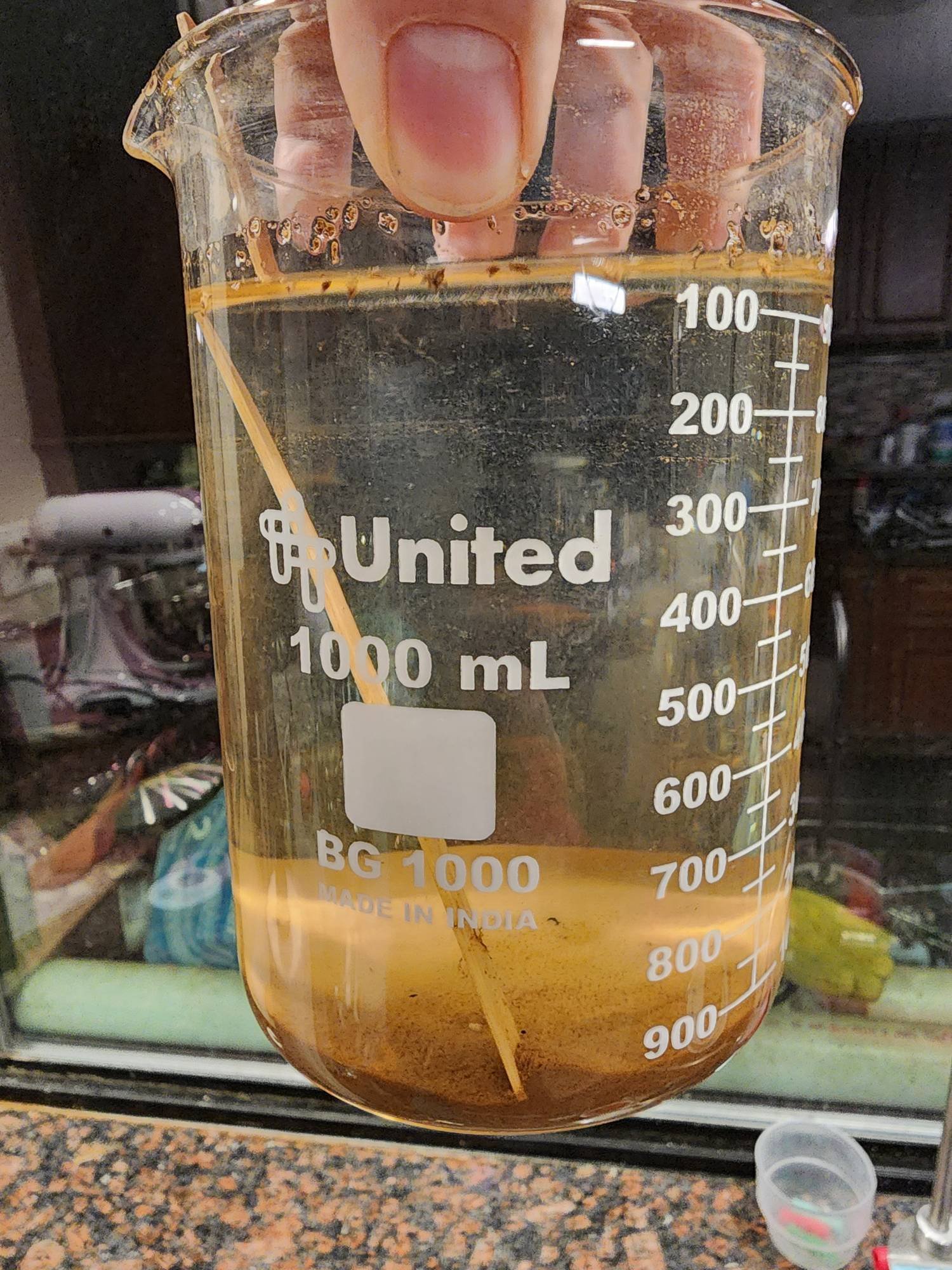
I recently spent about 30 minutes stirring, adding more PFS, more NPAM, more bentonite — nothing helped in this test setup. I had a bunch of fine particles that just would not go away. My pH was fine and it should have worked, but I was losing the war on clarity.
That was until I took a pinch of Polyaluminum Chloride, threw it in, and stirred. The residual particles started to move downward, and clear water was appearing at the top. I had just wasted half an hour because I was sure that if I just added more of the non-working component, the water would clear up. That was the wrong solution. Try another path — there is usually more than one possible solution, and the reason the full kit has a lot of items is that you may (or may not) need the options.
This was the final result, shortly after adding the PAC.
10. I know a bit about water chemistry. What is a good starting point?
If I knew that my water source was a muddy puddle on my lawn that likely didn't have any organic (sewage) matter in it, I would start with a jar test of PAC to coagulate and non-ionic PAM flocculant, and maintain a pH of 6 to 7. Maybe add a touch of bentonite clay, but do a couple of trials to set a baseline and work from those amounts. The goal is to reach just the point where the particle charges are reduced to neutral, and not past that point (charge reversal).
If I knew that my water source was a duck pond, and ducks are really inconsiderate about where they use the bathroom, I would start with polyferric sulfate and cationic PAM and a pH between 5.5 and 7 (acidic, but not battery acid).
These examples are starting points. To really find out what it takes to clean up your water, you have to test. I have a calculator on the website to serve as a starting point.
How to find out
Prepare stock solutions using low-ppm water: 1% PAC (1 gram in 100 mL), 0.1% xPAM (any PAM type; 1 g in 1 L), and 1% polyferric sulfate (1 gram in 100 mL). PAM degrades quickly, so plan to use it within a few hours.
Take a sample and feed it PAC and APAM, mix it, and let it settle. Still a little cloudy? Try some more. Still? Try some CPAM. Still not clear? Try filtering it through activated carbon or sand. The amounts are going to vary, but they will be tiny. Once you've identified the best "solution" in 1 L of water, you just need to scale up from 1 L to 20 L for a 5-gallon bucket. You should only have to experiment a few times to identify the most appropriate dosing for your situation. It is very easy to go too far.
PAM at as little as 0.1% (1 g in 1 L) can turn your water into slime. If you have a ball of slime you can actually pick up, your sample is overdosed. You are looking for beads of slime that you'd like to see meet up with your flocs and quickly drop them out of solution. This is the benefit of something like PAM as opposed to bentonite clay. Bentonite clay works by weighing down the flocs until they hit the bottom. This works, but it is slower. Ideally, your water treated with a PAC/PFS and PAM combination should begin to clump flocs together fairly quickly during gentle stirring. Wait for the flocs to coagulate, and then apply PAM while gently stirring, causing the PAM to connect with the flocs you made with the coagulant and drag them to the bottom.
The chemicals are not inherently hazardous, but they are not toys and should not be consumed directly. Water treated with cationic PAM should not be consumed directly, even though the risk of exposure to dangerous monomers is low at the levels involved here. Depending on your situation, it might still be an acceptable risk. (If you are trapped in a sewer, risking death from drinking the water, if CPAM gets you water you can add an Aquatab to and drink, you might want to use it anyway. It might be better than the alternative.) Or maybe stop playing around sewers.
11. pH adjustments
If you are not seeing coagulation with polyferric sulfate, add citric acid. Nothing? Try some more. At the right pH, everything works, and that is why there are two coagulants in this kit, even though PFS alone would have been suitable. Polyaluminum chloride can work at slightly higher pH levels than PFS. pH also affects solubility, so if things are dissolving, check the pH. Cold water may require more than hot water for the same effect.
A good option to add alkalinity is washing soda (or baking soda that has been baked). To make a solution more acidic, use citric acid. You will likely need tiny amounts. To decrease pH, mix 2 g of citric acid in 1 L of water and apply a few mL at a time. To increase pH, mix 2 g of washing soda in 1 L of water (0.2%) and apply a few mL at a time. Ideally, when done, your water should be around a pH of 7, neutral.
If you aren't seeing the results you expect, adjust your pH and try again with different dosing.
12. Why is there a time limit on how long this is usable?
Just about everything in this kit is hygroscopic. I recommend replacing the kit every couple of years, or within 12 months of opening.
The chemicals in this kit are designed to provide at least 5,000 gallons (1,000 five-gallon buckets) of water that can be further sanitized. A little goes a very long way.
13. My water isn't crystal clear after the chemicals.
Your water may need a higher dose of one or all of the components. You will have to experiment. You may also need additional filtration. I like ultrafiltration filters, but you can also make your own sand and/or activated carbon filter. Activated carbon may help with polyacrylamide monomers, too, though it isn't a guaranteed fix; reverse osmosis is the reliable option for those.
See Not Working? for more troubleshooting.
14. Why hasn't this been done before?
Generally, if you can find reasonably clear water and boil it and/or treat it for microbes, you'll probably be OK. However, if you are unlucky enough to be stuck in a flood or emergency, your options might be different. In the US, there have been instances where municipal water systems could not deliver safe, clean, clear (free of turbidity) water.
There is nothing special about using these chemicals that makes water safe to drink; they are used worldwide. The chemicals are relatively inexpensive in bulk.
Water is a critical commodity, and in an emergency it may be scarce. There are lots of products on the market that purify water of questionable origin. Those products need a supply of water that won't clog them. This water haziness is called turbidity, and it's a problem on several levels:
- It makes water harder to sanitize.
- It can clog your purifier's filter.
15. Why am I only hearing about this now?
Big water treatment doesn't want you to know about this one little trick.
Truthfully, I suspect it's never been on anyone's radar. These chemicals are not water purification products on their own, but they are a great companion to a sanitizing solution. I think they are the perfect companion to Aquatabs, a membrane straw, or a hand-pumped purifier, and they may be enough for hand washing with only solar disinfection and/or bleach. A word of caution: Giardia and other parasites lurk in crystal-clear streams and can be chlorine resistant.
16. These chemicals are cheap. Why are you selling them for that price?
Shipping, packaging, and regulatory/customs compliance were all hard, and even getting a company to work with me was hard. Getting someone to put it in bags was brutal; most fillers won't do chemicals if they do food. Most suppliers didn't want to be bothered and did not care that I wanted to buy some. "Hi, could I get a few lbs of... hello?..." Damn it, again? Amazon wants their cut (about 40% of the product cost). We also needed to pay someone to make a dumb website with this Q&A on it. It went to the lowest bidder.
If you look at water sanitizing products like Aquatabs, you will note that one tablet will sanitize twice as much clear water as cloudy water. Looking at it another way, you double your water capacity if you can eliminate the turbidity.
The lifespan of your membrane straw is much better with clear water.
Giardia and Cryptosporidium, chlorine-resistant parasites, are readily killed in clear water with a UV light source (including the sun; see solar water disinfection, or SODIS). Other contaminants may be caught by cheesecloth or a sand or carbon filter.
You can probably see where I am going with this. Pre-treat the water to drop out as much crud as possible, and you save yourself a lot of issues downstream.
17. What else can it do?
Rainwater harvesting. Rainwater from tarps, roofs, and even puddles can be made into usable water if properly treated. You generally should not use rainwater off the roof to water edible plants, as the contents of the roof end up in that water, and they are not clean.
However, what if you are desperate? I heard the residents of Rio Verde Foothills ran into a little problem after the city of Scottsdale told them to "get their own water," as they were not part of the city of Scottsdale. After more than a year of warnings, Scottsdale finally made good on its promise and cut them off on January 1, 2023. Water deliveries through Scottsdale resumed about nine months later under a temporary agreement, and it took three years for a permanent solution to arrive (AZFamily, December 30, 2025).
What could you do in the interim? I think you could get very creative with what you have. Rainwater capture with coagulation, flocculation, filtering, and sanitation could have made up a lot of the water that was lost.
18. This product is too heavy to take camping.
Feel free to share it with 10 friends. In a world of shrinkflation, where you are paying more for less, how about getting more for a change?
19. Why?
I did it all wrong. I thought computers were the future. The Apple IIe was a captivating, amazing device and was priced at about a third of the cost of an economy car of the time. It could have this device called a "modem" that let it talk to other computers. This is it, I'm going to work with computers.
In the 1980s, I lived in Los Angeles, and Santa Monica beach had terrible, often unsafe, bacteria levels in the ocean. Sewage outflows were common, and the Hyperion plant in Playa del Rey was a big part of the problem. I used to ask my parents questions like "How much sewage is in Santa Monica Bay?" I didn't realize at the time that there was no way to really calculate that, but leave it to my dad: he made up a number. I'm sure he thought, "This kid's going to grow up to work on computers or water treatment." Kid, go play with the computer.
In 1996, I was house-sitting in Morro Bay, CA, for the summer. It was a great time; I was two blocks from the beach, and the weather was absolutely perfect (70 degrees year-round). However, Morro Bay had a water problem. They were using wells for drinking water, and there were issues with saltwater intrusion. The city had built a desalination plant in 1992 to help solve these issues. The plant went mostly unused, and the city eventually contracted with the California State Water Project to supply water. I would have liked to see them make use of their desalination plant and take advantage of their proximity to major power plants to run the RO plants during times of low power demand. Alas, I wasn't in a position at the time to push the issue, and I was having a hard enough time remaining enrolled in college. If you give college a "try" too many times, they, very unsubtly, ask you to "try" something else.
At about the same time, there was a community just to the south of Morro Bay, Los Osos, that had a different problem. The community didn't have a sewer system, and the septic systems were affecting groundwater. They needed to retrofit a municipal sewage system at enormous cost to the residents — around $180 million for the project after overruns. Today, residents pay some of the highest sewer rates anywhere in the US. There are other communities in San Luis Obispo County that had their own issues with water supplies, which has led to building moratoriums and rationing of water. All this in communities next to a limitless supply of water, none of it drinkable.
In both Morro Bay and Los Osos, the communities took the most expedient option, but what if they hadn't? How hard was it to treat water? Based on my limited understanding of chemistry and my ability to forget that everything costs money, water treatment and reuse didn't strike me as overly complicated.
It went something like this:
- Sewage flows into a septic tank.
- Employ coagulation and flocculation to get solids to settle out in the tank. Get it pumped out every once in a while.
- Further clarify the water (pump water into another tank and let it sit there).
- Filter only the now-clearer water through ultrafiltration and/or RO membranes.
- Sanitize the water.
- Dump clean water on the ground.
Instead, the collective residents of Los Osos were put on the hook for $180M.
In 2024, I realized I'm not getting any younger and I should try my hand at water reuse, as I live in the desert. How hard can this be? You can buy anything on Amazon. Well, yes you can, but what if you don't need lab-grade chemicals? What if you just wanted a pound of coagulant? I called several US distributors and was pretty universally told, "Yeaah, we don't really deal with small amounts and average consumers." Could I maybe just get a sample? "Yeeeaaaah, we really aren't equipped to do that. We don't take credit cards." I got pretty much nowhere.
COVID was over; I thought I had options. Would a company in China sell me these chemicals? "Yeaah, we really don't sell to end consumers." How much would I need to buy to get these chemicals? The minimum was one ton. One metric ton, or 2,200 lbs. Where was I going to put 2,200 lbs of coagulant? How would I even get it here? That in itself was a learning experience.
I finally found ONE company that would send me some samples for basically the cost of shipping. This is it — finally I was going to get the chemicals. I think I ordered 25 kg. They were seized by Chinese customs. Fentanyl and white powders were on everyone's radar. I guess the paperwork wasn't in order? Three months later, it was declared lost. Let's try it again, with more complete paperwork. The website indicated it was stuck in La Puente, CA, but would depart the facility soon. Soon never came; it was seized by US customs. AGAIN? I was done. Forget it, game over. I got a different salesperson, and she was willing to give it one more shot. It made it — about 2 lbs in total — and the chemicals finally masde it!
A couple of grams of these chemicals and you could be clearing up whatever water you had available. How much do I have to buy? One metric ton. How do I get it here? A container and freight forwarders. I wonder if anyone else has a similar need. I'm going to make a kit. Here's my list. I thought my problems were over; this was going to be great. I was going to bring a new product to market. Uh, not so fast.
I needed someone to fill the bags with this stuff, except I was met with "Uh, no, we don't do chemicals." They're not hazardous. "Yeaah, we don't do chemicals." After multiple rejections, I was made aware of a facility in Arizona that packaged pesticides. They said they would have to clean and sanitize the equipment before and after, but they had the equipment necessary to verify it was actually clean, and they could do it in about five months.
Since this company didn't usually handle water treatment chemicals, they weren't sure what the throughput would be in filling. OK, so how much is this going to cost? "We don't know, we may have to just charge you a per-day rate." How much is that? "Well, it can vary. We'd like to do a test batch."
Now, as I mentioned above, there is no such thing as a small amount when it comes to water treatment chemicals. I would need to import all of it at once and just send them a small amount when it got here.
Unable to secure a production slot in a realistic time frame, I was forced to have the bags filled in China and then the components sent to a kitting facility in Tucson for assembly. In Tucson, adults with developmental disabilities put them together. That may have been one of the more rewarding components of this little adventure, as it was a reminder that everyone can contribute.
I made 5,000 kits. I'm really not sure if there will ever be more, because I'm really not sure I can deal with sleeping four hours a night anymore. Get them while you can!